
Unfazed by the rejection of his bill, Sports Minister Ajay Maken on Thursday said he would talk to his cabinet colleagues to convince them, but ruled out any dialogue with Board of Control for Cricket in India bigwigs.
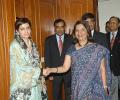
India on Friday made it clear to Pakistan that resolution of the Kashmir issue cannot take place under the "shadow of gun" as the two countries concluded "satisfactory" talks which resulted in agreement on various confidence building measures.
The proposal for including cruise missile tests in the existing bilateral agreement on Pre-Notification Of Flight Testing Of Ballistic Missiles, signed in October 2005, was mooted by the Indian side during Thursday's talks between the foreign secretaries on peace and security, sources familiar with the discussions told PTI
Foreign Secretary Nirupama Rao, who arrived in Islamabad on Thursday on a two-day visit, began talks on Friday with her Pakistani counterpart Salman Bashir on Kashmir. The two-day talks have been divided into three segments under which the issue of peace and security, including confidence-building measures, was discussed on Thursday. After Jammu and Kashmir, the talks will be held on the promotion of friendly exchanges
Pakistan on Friday said that its foreign minister will be travelling to India in July to take forward the bilateral peace process. "What we can deliver at this stage is that our foreign minister will be visiting New Delhi in July," said Pakistan High Commissioner to India Shahid Malik. On the ongoing foreign secretary-level talks, Malik said, "They are going well." Pakistan currently has Hina Rabbani Khar as minister of state for foreign affairs.
India's concerns over terror and slow pace of Mumbai trial were discussed in the first round of Indo-Pak foreign secretary-level talks dealing with the issue of peace and security during which the Samjhuta bomb blast case also came up with both sides holding "substantive" deliberations in a "forward looking" approach.
Six Indian sailors, who were part of the 22-member crew of MV Suez vessel that was recently freed by Somali pirates, on Thursday reached Karachi harbour and would be sent back to India soon.
The leaders of the Brazil-Russia-India-China-South Africa grouping on Thursday collectively voiced their opposition to the use of force in Libya and pitched for a central role for the United Nations and regional organisations in resolving the matter.Reflecting on the situation in the Middle East and north African countries at the BRICS Summit, Prime Minister Manmohan Singh observed that there was a "shift of power towards ordinary citizens".

In a first-of-its-kind step, Brazil, Russia, India, China and South Africa (BRICS) will be signing an agreement on Thursday under which they would be able to give credit and grants to each other in their own currency instead of dollars.
India has assured Pakistan that it would not hesitate from sharing the findings of Samjhauta Express blast case but expressed inability to do so till the probe is not completed as Indian laws do not permit it. This message was conveyed by Foreign Secretary Nirupama Rao during her meeting with her Pakistani counterpart Salman Bashir.
Pakistan expressed its desire to have "cordial and cooperative" ties with India, a day after the two sides agreed to have "constructive" engagement aimed at restoring the stalled dialogue process.
With India raising concern over Pakistan's increasing involvement in Afghanistan's transition process, President Hamid Karzai on Sunday assured visiting External Affairs Minister S M Krishna that his government will not make any move that is detrimental to New Delhi's interest. Karzai sought to allay India's concerns during his meeting with Krishna, who is in Kabul on a two-day visit. The Afghan President assured Krishna that India was 'uppermost' on his prioritiy list.
Ahead of the visit by Premier Wen Jiabao, senior Chinese Communist Party leader Zhou You Kang will be in India from Sunday on a two-day trip during which the bilateral relations will be discussed.
India dismissed any apprehensions in Beijing about India forging closer ties with Japan, Malaysia and Vietnam to encircle China, saying these were stand-alone bilateral relations not predicated on any other country.

The average age of an Indian by 2020 would be 29 years as compared to 29 years in case of China and 48 for Japan.

Seeking to give new impetus to the bilateral relations, India and Malaysia today formally announced firming up of Comprehensive Economic Cooperation Agreement (CECA) to boost trade and decided on a range of other engagements in various sectors, including defence.

Singh hailed Malaysian companies particularly in the infrastructure sector for their good reputation and asked them 'to take a long term and strategic view' of the Indian economy and market.

He, however, admitted that there are challenges to recording such a high economic growth.

Observing that infrastructure deficit was posing a major constraint to India's growth, Prime Minister Manmohan Singh on Monday said an outlay of over $1 trillion was envisaged for infrastructure projects during the next 5-year plan beginning 2012 and invited Japanese firms to play a greater role in this endeavour.
Prime Minister Manmohan Singh arrived in Tokyo on the first leg of his three-nation visit, during which he would hold talks with his Japanese counterpart Naoto Kan on a range of issues, including civil nuclear energy cooperation.
 © 2026 Rediff.com - Advertise with us - Disclaimer - Privacy Policy - Sitemap - Feedback - About us - Terms of use - Grievances